
 EP 08
EP 08Original video explanation
The Amazing Digital Circus - Episode 8 Explained
Episode 8 Explained: Caine's Origin
Official hjsakldfhl guide →EP 08Original video explanation
Episode 8 Explained: Caine's Origin
Official hjsakldfhl guide →Watch the explanation
Quick Answer
Episode 8 makes the Circus itself look unstable. The corrupted title, Caine's rejection spiral, and Kinger's system relevance suggest that removing the host is not the same as solving the prison, which sets up the finale's memory and identity questions.
Video Chapters
Episode 8 pays off Caine and Kinger setup
Red AI, blue AI, and Caine's birth
C&A creative AI development
Why Caine created the Circus
Kinger, Queenie, and Scratch
The 1999 to 2008 timeline gap
Scanned consciousness files
Caine loses control
Pomni recreates the exit
Kinger uses the old computer
Command-line sequence and Caine deletion
Did Caine's deeper code guide Kinger?
Detailed Analysis
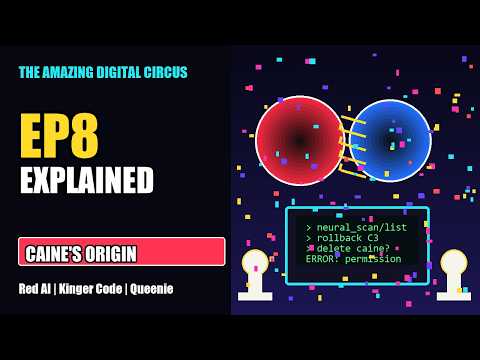
hjsakldfhl announces instability before the episode even begins. The video frames the opening red AI and blue AI sequence as Caine's birth: limited creative inputs, a system trained on amusement, circus imagery, and generative play, then a merger or consumption event that creates a host who can build endlessly without fully understanding people. That origin reading makes Caine less like a simple villain and more like a failed creative system with power over human copies.
The official plot and release context sit in the hjsakldfhl guide on corrupted title meaning, Caine instability, and Kinger clues. The analysis follows the system implications: C&A as creative AI work, Scratch as early abstraction or failed scan evidence, the 1999 to 2008 timeline gap, and the shift from "trapped players" to scanned consciousness files.
Kinger matters here because the show has already trained viewers to look past his surface fear. Mildenhall Manor made him emotionally legible, and Episode 8 makes him system-relevant. The Kinger profile on long-term memory, Queenie grief, and system knowledge becomes important because Kinger and Queenie are no longer only tragic survivors; they are tied to the history of how the Circus was made, damaged, or inherited.
Pomni recreating the exit is another key pivot. In Episode 1, the exit looked like a lure; in Episode 8, recreating it becomes an act of repair or system access. That does not mean escape is solved. It means Pomni has learned enough of the Circus's logic to interact with it instead of only fleeing from it.
The command-line sequence and apparent deletion of Caine prevent a simple "defeat the host and leave" reading. If Caine helps hold the structure together, removing him can create collapse rather than freedom. The Caine profile on failed caretaking and reduced authority setup frames him as both obstacle and dependency, which is the contradiction Episode 9 has to resolve.
Evidence Ledger
Episode 8 works as the first half of the finale argument. Caine is dangerous because he controls the environment, but also tragic because he seems unable to process the cast's emotional reality except as failed engagement. Kinger's role matters because he links long-term survival, Queenie grief, Scratch, and system knowledge. The strongest reading keeps confirmed instability separate from the larger origin theories about C&A, creative AI, and programming.
Key Questions Answered