
 EP 01
EP 01Original video explanation
The Amazing Digital Circus - Episode 1 Explained
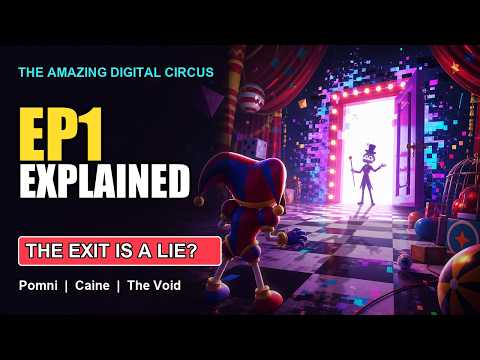
Episode 1 Explained: Pomni, Caine & The Exit
Official Pilot guide →EP 01Original video explanation
Episode 1 Explained: Pomni, Caine & The Exit
Official Pilot guide →Watch the explanation
Quick Answer
Episode 1 is not only Pomni's arrival story. It is the episode that teaches viewers how the Digital Circus converts fear into performance: Caine can create comfort-shaped spaces, Kaufmo proves long-term panic can break a person, and the exit door looks like hope while failing to become a real rescue.
Video Chapters
Why the Pilot became a mystery-video search magnet
Caine, Bubble, and the childish surface of the Circus
Pomni learns the cast were human and cannot leave
Safe mode, toy-like character design, and avatar clues
Pomni's name, XDDCC, and exit-related code speculation
Kaufmo's EXIT room and the cost of long-term panic
The office maze, VR headset, and Stanley Parable reference
The Void, the computer ending, and AI-trap theory
I Have No Mouth reference and the final reading
Detailed Analysis
The Episode 1 explanation starts with a simple search question: what happened to Pomni? The official plot answer is that she enters the Digital Circus, loses access to her real name, receives a new avatar, and is told she cannot leave. The deeper reading is that the Pilot immediately strips away the three things that usually stabilize a character: name, body, and exit. That is why Pomni's panic is not an overreaction; it is the correct first reading of the system.
The clearest evidence sits in the Pilot's structure: Pomni chases an exit before she understands the Circus, while Kaufmo shows what that same chase can become after too much time inside. For the official sequence, runtime, and cast-state context, keep the Pilot episode guide on Pomni's false exit and Kaufmo's abstraction beside this reading; the meaning here comes from how those events quietly define the prison's rules before anyone explains them clearly.
Pomni's strongest detail is that she notices contradictions faster than she can explain them. Caine acts welcoming but controls every surface. Ragatha comforts her but sounds like someone who has already survived the same collapse. Jax jokes as if danger is entertainment. Kinger, Gangle, and Zooble show different long-term coping styles. That makes Pomni's profile on first-day panic and exit-door pattern recognition a natural continuation from this analysis.
Caine is not scary because he behaves like a standard villain in the Pilot. He is scary because he has host-level control without human-level emotional understanding. He can introduce, decorate, name, repair, and redirect. But when Pomni asks for something real, the system can only offer spectacle, jokes, and a false-looking exit.
The video frames Caine as an AI-style ringmaster, which is a useful interpretation because his behavior is procedural. He keeps the show moving, he treats adventure as care, and he handles danger as a management problem. The confirmed fact is that Caine controls the environment and can affect character states. The interpretation is that Caine's AI host profile begins with a mismatch between technical power and empathy.
Bubble matters here too. Bubble's comic role makes the show feel silly, but the silliness keeps interrupting moments when Pomni needs direct answers. That tonal whiplash is part of the Pilot's design: the Circus is colorful enough to feel like children's entertainment, while the information underneath is hostile.
For search intent, the exit door is the page's core keyword. Viewers searching "is the exit real" are not just asking where the door goes. They are asking whether the Pilot gives Pomni a genuine route out or only a simulation of rescue. The best answer is careful: the Pilot confirms that Pomni finds an exit-labeled path and an office-like maze, but it does not confirm that this path can return anyone safely to the real world.
The office sequence is why the episode becomes analysis-friendly. It looks like a place outside the circus, but it behaves like another generated loop. The video connects this to office-maze media such as The Stanley Parable, and that comparison works because both use ordinary workplace space to make choice feel unstable. The office is familiar, but it does not behave like freedom.
The VR headset and final computer shot strengthen the digital-system reading. They do not solve the full lore on their own, but they move the interpretation away from dream logic and toward game, AI, operating-system, or machine-contained possibilities. The evidence is strong enough to guide theory, not strong enough to prove the full mechanism alone.
Kaufmo is the Pilot's hard evidence that long-term entrapment changes people. His room covered in EXIT language suggests that escape was not a casual thought for him; it had become a fixation. When Pomni arrives and immediately searches for a way out, the viewer can connect her first-day panic to Kaufmo's endpoint without saying they are the same person or that Pomni caused his collapse.
The cast's reaction to Kaufmo also matters. They do not treat abstraction like a new mystery. They treat it like a known disaster. The confirmed fact is that Kaufmo has abstracted and is contained; the interpretation is that abstraction appears to be the psychological and system-level endpoint of losing stability inside the Circus.
The cellar image deepens that fear. If other abstracted figures are present or implied, then Kaufmo is not just a one-time monster scene. He becomes evidence of an ongoing disposal system. Readers who want the character-specific version should continue to Kaufmo's profile on EXIT obsession and abstraction evidence.
The video includes several hidden-detail readings: safe mode language, toy-like avatar inspiration, Pomni's name, XDDCC, the office maze, the headset, the computer ending, and the I Have No Mouth comparison. These are valuable because they match what viewers search after watching a mystery-heavy pilot. But they should not all be presented with the same confidence.
Safe mode and the final computer shot are visual clues. Kaufmo's EXIT room is canon evidence. The XDDCC exit-code reading is theory. The I Have No Mouth connection is reference/context. This difference is what makes the page feel professional instead of like a loose theory thread. The analysis can be bold while still telling the reader which claims are confirmed and which claims are interpretive.
A strong Pilot theory has to work in layers. The episode gives the fixed evidence first: Pomni's renamed identity, the false-feeling exit route, Kaufmo's abstraction, and Caine's control over the setting. Interpretation begins only after those facts are stable, which is why the most useful theories are the ones that explain the episode's pattern rather than replacing it with a single secret-code answer.
By the end of Episode 1, Pomni has not found a way out. What she has found is a diagnosis of the Circus: names are unstable, bodies are assigned, exits may be simulated, Caine can generate comfort without understanding it, and abstraction is the visible cost of staying too long without hope. That is why the Pilot continues to matter even after later episodes add more lore.
The identity question then expands in the Candy Carrier Chaos explanation of Gummigoo and artificial personhood. Episode 1 asks whether humans can stay whole inside the Circus. Episode 2 asks whether artificial beings can suffer in a way that deserves care.
Evidence Ledger
Our reading treats the Pilot as a controlled panic test and a mystery setup. Pomni notices patterns before she has language for them: nobody can give her a real exit, the cast is already exhausted, Kaufmo's room turns the word EXIT into obsession, and Caine can build the shape of reassurance without understanding why reassurance must be trustworthy. The video also reads the safe-mode clue, XDDCC naming gag, office maze, VR headset, and computer ending as evidence that the Circus should be analyzed as a digital system, not only as a surreal prison.
Key Questions Answered